Start with the 18 featured FE Civil practice problems below, then work through the topic sets covering mathematics, statics, dynamics, structural engineering, geotechnical engineering, transportation, construction and every other FE Civil exam topic. Every problem is original, written against the current NCEES FE Civil specification, and comes with a step-by-step solution that cites where the equation lives in the FE Reference Handbook.
There are 96 free problems across this page and the topic sets — no account, no card, no email required. The directory below shows exactly how they are distributed, and how many questions each topic is worth on the real 110-question exam, so you can spend your time where the exam actually spends its questions.
Try These Featured Visual Problems
These come straight from the PECivilClick FE Civil bank — the same clean, exam-style diagrams you get inside the platform. Pick an answer and see instantly whether you are right.
Surveying — Departure from a Bearing
A line has bearing S 53.13° E and length \( 200\,\mathrm{m} \). What is the departure (east is positive), nearest \( 0.1\,\mathrm{m} \)?

Answer: B) \( +160.0\,\mathrm{m} \)
Step 1 – Identify given information:
| Parameter | Value |
|---|---|
| Line length \( L \) | \( 200\,\text{m} \) |
| Bearing | S 53.13° E |
Step 2 – Departure formula (FE Handbook):
\( \text{Dep} = L \sin(\text{bearing angle}) \)
SE quadrant: departure is positive (eastward).
Step 3 – Substitute and solve:
\( \text{Dep} = 200 \sin(53.13^\circ) = 200 \times 0.8 = +160.0\,\text{m} \)
Note: \( \sin(53.13^\circ) = 0.8 \) exactly (this is a 3-4-5 triangle angle).
Step 4 – Answer:
The departure is \( +160.0\,\text{m} \) (eastward).
(A) \( +120.0\,\text{m} \) is the latitude magnitude \( L\cos(53.13^\circ) = 200(0.6) \), not the departure.
(C) \( -120.0\,\text{m} \) has the wrong sign and wrong trig function.
(D) \( -160.0\,\text{m} \) has the wrong sign; SE bearing gives positive departure.
Correct answer: (B)
Dynamics — Work-Energy on an Incline
A \( 15\,\mathrm{kg} \) block is pushed up a \( 20^\circ \) incline by a constant force of \( 120\,\mathrm{N} \) parallel to the incline. Starting from rest, it moves \( 5.0\,\mathrm{m} \). Neglect friction. What is its speed at \( 5.0\,\mathrm{m} \) \( (\mathrm{m/s}) \)?

Answer: D) 6.8
Step 1 – Identify given information:
| Mass | \( m = 15\,\text{kg} \) |
| Applied force | \( P = 120\,\text{N} \) (parallel to incline) |
| Incline angle | \( \theta = 20^\circ \), no friction |
| Distance | \( s = 5.0\,\text{m} \), from rest |
Step 2 – Work-energy theorem: \( F_{\text{net}} \cdot s = \frac{1}{2}mv^2 \).
Step 3 – Solve:
$$F_{\text{net}} = 120 - 15(9.81)\sin 20^\circ = 120 - 50.3 = 69.7\,\text{N}$$
$$v = \sqrt{\frac{2(69.7)(5)}{15}} = \sqrt{\frac{697}{15}} = \sqrt{46.5} \approx 6.8\,\text{m/s}$$
Step 4 – Answer: The speed after \( 5\,\text{m} \) is approximately \( 6.8\,\text{m/s} \). The correct answer is (D).
Option (C), 4.8, is what you get by leaving the one-half out of the kinetic energy; (B), 4.6, is the acceleration \( F_{\text{net}}/m \) in \( \text{m/s}^2 \) handed in as a speed; (A), 3.0, drops the distance from the work term.
Engineering Economics — Break-Even Volume
A company manufactures concrete splash blocks with the following cost structure, shown on the break-even chart:
• Fixed costs: \(\$240{,}000\) per year
• Variable cost: \(\$18\) per unit
• Selling price: \(\$30\) per unit
How many splash blocks must be sold annually to break even?

Answer: C) 20{,}000 units
Handbook: FE Reference Handbook 10.6, Engineering Economics → Breakeven Analysis, p. 236 (PDF viewer: page 242). The page defines the breakeven point in words but gives no formula, so set the equation up yourself.
Step 1 – Write both lines.
$$\text{Revenue} = 30Q, \qquad \text{Total cost} = 240{,}000 + 18Q$$
Step 2 – Set them equal and solve.
$$30Q = 240{,}000 + 18Q \quad\Longrightarrow\quad 12Q = 240{,}000$$
$$Q^{*} = \frac{240{,}000}{30 - 18} = \mathbf{20{,}000 \text{ units}}$$
Step 3 – Answer: (C).
Think in contribution margin. Every barrier sells for \(\$30\) and costs \(\$18\) to build, so it contributes \(\$12\) toward the fixed costs. Covering \(\$240{,}000\) of fixed cost therefore takes \(240{,}000/12 = 20{,}000\) units. The margin — not the price, not the variable cost — is the only rate that matters.
Check it. At 20,000 units: revenue \(= 30(20{,}000) = \$600{,}000\); total cost \(= 240{,}000 + 18(20{,}000) = 240{,}000 + 360{,}000 = \$600{,}000\). They match.
A note on the margin. Here the contribution is 40% of the selling price (\(\$12\) of \(\$30\)), a thinner margin than it looks: the plant must move 20,000 units a year before it earns its first dollar of profit.
Step 4 – Eliminate the distractors. Each divides the fixed cost by the wrong figure:
(A) 13,333 units \(= 240{,}000/18\) divides by the variable cost. That number answers a different question entirely — how many units' worth of variable cost equals the fixed cost.
(B) 8,000 units \(= 240{,}000/30\) divides by the price, as though all \(\$30\) of each sale were available to cover fixed costs. It ignores the \(\$18\) spent to build each unit.
(D) 5,000 units \(= 240{,}000/(30 + 18)\) adds the variable cost to the price instead of subtracting it. A sign error, and it makes the operation look four times more profitable than it is.
Transportation — Intersection Angle from the Long Chord
A simple circular curve has radius \( R = 650 \,\mathrm{ft} \) and long chord \( LC = 900 \,\mathrm{ft} \). What is the intersection angle \( \Delta \) (deg), nearest \( 0.1 \) deg?
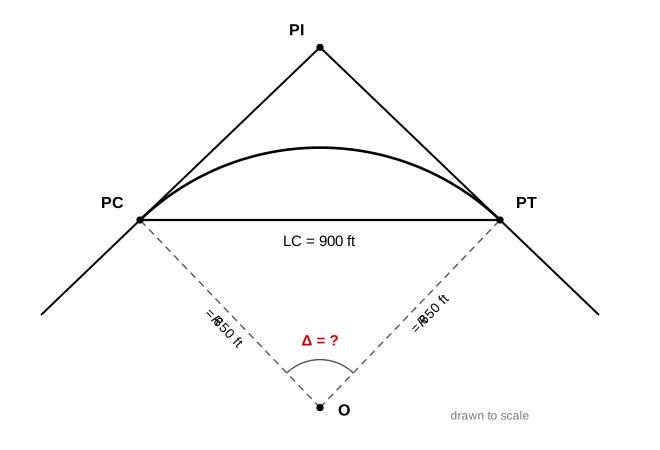
Answer: B) \( 87.6^\circ \)
Step 1 – Recall the long chord formula for a simple circular curve:
From the FE Handbook, the long chord \( LC \) relates to the radius \( R \) and intersection angle \( \Delta \) by:
$$ LC = 2R \sin\left(\frac{\Delta}{2}\right) $$
Step 2 – Rearrange to solve for \( \Delta \):
$$ \sin\left(\frac{\Delta}{2}\right) = \frac{LC}{2R} $$
Step 3 – Substitute the given values (\( R = 650\,\mathrm{ft} \), \( LC = 900\,\mathrm{ft} \)):
$$ \sin\left(\frac{\Delta}{2}\right) = \frac{900}{2 \times 650} = \frac{900}{1{,}300} = 0.6923 $$
Step 4 – Solve for \( \Delta/2 \) using inverse sine:
$$ \frac{\Delta}{2} = \sin^{-1}(0.6923) = 43.813^\circ $$
Step 5 – Find the full intersection angle:
$$ \Delta = 2 \times 43.813^\circ = 87.626^\circ \approx 87.6^\circ $$
Correct answer: (B)
Mechanics of Materials — Reaction of an Overhanging Beam
A simply supported beam has supports at A (\( x = 0 \)) and B (\( x = 4\,\mathrm{m} \)), with a \( 1\,\mathrm{m} \) overhang to the right (free end at \( x = 5\,\mathrm{m} \)). A downward point load \( P = 5\,\mathrm{kN} \) acts at the free end. What is the reaction at A (kN)?

Answer: A) −1.25
Step 1 – Identify given information:
Span A to B = 4 m, overhang = 1 m, \( P = 5 \;\text{kN} \) at free end (\( x = 5 \;\text{m} \)).
Step 2 – Moment equilibrium about A (FE Handbook):
\( \sum M_A = 0 \): \( R_B \times 4 = P \times 5 \)
Step 3 – Solve:
\( R_B = \frac{5 \times 5}{4} = 6.25 \;\text{kN} \) (upward)
\( R_A = 5 - 6.25 = -1.25 \;\text{kN} \) (negative means downward — uplift reaction)
Step 4 – Answer: \( R_A = -1.25 \;\text{kN} \) (uplift). Overhanging loads can cause uplift at the far support, requiring anchorage at A.
Correct answer: (A)
Water Resources — Electrodialysis Current
Electrodialysis treats a \( 0.02\,\mathrm{N} \) NaCl solution at a flow rate of \( 0.50\,\mathrm{L/s} \). If \( 60\% \) of the salt is removed, and the current efficiency is \( 98\% \), what current is most nearly required? (Use Faraday's constant \( F = 96{,}485\,\mathrm{C/equivalent} \).)

Answer: C) \( 590\,\mathrm{A} \)
Step 1 – Identify given information:
$$Equivalents removed per second = Q·N·rem = 0.50·0.02·0.60 = 0.0060 eq/s$$
Step 2 – Apply formula:
$$Ideal current = F·(eq/s)= 579 A$$
Step 3 – Solve:
$$Actual I = ideal/η = 579/0.98 ≈ 591 A ≈ 590 A$$
(B) \( 390\,\text{A} \) charges the current to the 40 per cent of the salt that STAYS in the water instead of the 60 per cent actually driven across the membranes.
(A) \( 350\,\text{A} \) and (D) \( 820\,\text{A} \) follow from neither route; note that omitting the 98 per cent current efficiency altogether would give \( 579\,\text{A} \), which still rounds to the key.
Correct answer: (C)
Want problems like these for every topic? The full platform has 1,150+ FE Civil problems — each with a diagram and a step-by-step worked solution, plus timed CBT simulations under the real 5 hr 20 min clock. Start your 7-day free trial →
Free FE Civil practice problems by topic
| FE Civil topic | Free problems | Difficulty | Approx. time | Questions on the real exam |
|---|---|---|---|---|
| FE Civil Water Resources and Environmental | 5 | 1 easy · 2 med · 2 hard | ~15 min | 10-15 |
| FE Civil Structural Engineering | 5 | 1 easy · 2 med · 2 hard | ~15 min | 10-15 |
| FE Civil Geotechnical Engineering | 5 | 1 easy · 2 med · 2 hard | ~15 min | 10-15 |
| FE Civil Transportation Engineering | 5 | 1 easy · 2 med · 2 hard | ~15 min | 9-14 |
| FE Civil Mathematics and Statistics | 5 | 1 easy · 2 med · 2 hard | ~15 min | 8-12 |
| FE Civil Statics | 5 | 1 easy · 2 med · 2 hard | ~15 min | 8-12 |
| FE Civil Construction Engineering | 5 | 1 easy · 2 med · 2 hard | ~15 min | 8-12 |
| FE Civil Mechanics of Materials | 5 | 1 easy · 2 med · 2 hard | ~15 min | 7-11 |
| FE Civil Fluid Mechanics | 5 | 1 easy · 2 med · 2 hard | ~15 min | 6-9 |
| FE Civil Surveying | 5 | 1 easy · 2 med · 2 hard | ~15 min | 6-9 |
| FE Civil Engineering Economics | 5 | 1 easy · 2 med · 2 hard | ~15 min | 5-8 |
| FE Civil Materials | 5 | 1 easy · 2 med · 2 hard | ~15 min | 5-8 |
| FE Civil Ethics and Professional Practice | 5 | 1 easy · 2 med · 2 hard | ~15 min | 4-6 |
| FE Civil Dynamics | 5 | 1 easy · 2 med · 2 hard | ~15 min | 4-6 |
| FE Civil Truss Analysis (Statics deep dive) | 8 | 2 easy · 6 med | ~24 min | part of Statics |
| Featured set on this page | 18 | Mixed | ~54 min | Mixed topics |
| Total free problems | 96 | — | ~5 hr | — |
How to Use This Resource: Try solving each problem on your own before clicking "Show Solution." Use the NCEES FE Reference Handbook as you would on exam day. Time yourself -- aim for about 3 minutes per problem to simulate real exam pacing.
Why Practice Problems Matter
Research consistently shows that active recall -- the process of retrieving information from memory -- is one of the most effective study strategies. Simply re-reading notes or watching videos is passive learning. Working through problems forces your brain to actively engage with the material, strengthening neural pathways and improving long-term retention.
Identify Weak Areas
Practice problems reveal exactly which topics need more study time, so you can prioritize efficiently.
Build Exam Pacing
The FE exam gives you about 3 minutes per question. Regular practice builds the speed you need.
Learn the Reference Handbook
Practice problems teach you where to find formulas and tables in the FE Reference Handbook quickly.
Boost Confidence
The more problems you solve correctly, the more confident you will feel walking into the testing center.
Mathematics (2 Problems)
NCEES assigns Mathematics and Statistics 8 to 12 of the 110 questions on the FE Civil exam. Topics include analytic geometry, single-variable calculus, vector operations, and statistics.
Problem 1 — Probability of A or B
A bag contains balls numbered 1 to 50. One ball is selected. What is P(the number is odd OR a multiple of 7)?
Answer: D) 0.56
Step 1: Identify given information
| Item | Value |
|---|---|
| Sample space | Balls numbered 1 to 50 |
| Event A | Number is odd |
| Event B | Number is a multiple of 7 |
| Find | \(P(A \cup B)\) |
Step 2: Recall the inclusion-exclusion formula from the FE Handbook
$$P(A \cup B) = P(A) + P(B) - P(A \cap B)$$
This prevents double-counting elements that belong to both events.
Step 3: Count each set
| Set | Elements | Count |
|---|---|---|
| \(A\) (odd numbers) | 1, 3, 5, ..., 49 | 25 |
| \(B\) (multiples of 7) | 7, 14, 21, 28, 35, 42, 49 | 7 |
| \(A \cap B\) (odd multiples of 7) | 7, 21, 35, 49 | 4 |
Step 4: Apply the formula
$$|A \cup B| = 25 + 7 - 4 = 28$$
$$P(A \cup B) = \frac{28}{50} = 0.56$$
Note: 14, 28, and 42 are even multiples of 7, so they are in \(B\) but not in \(A \cap B\).
Option (A) is what you get by computing the intersection instead of the union, counting only the four odd multiples of 7 and dividing by 50.
Correct answer: (D)
Problem 2 — Logarithmic Differentiation
Find \(\frac{d}{dx}\) of \(y = (3x)^{2x}\).
Answer: A) \((3x)^{2x}(2\ln(3x) + 2)\)
Step 1 – Identify the function: \(y = (3x)^{2x}\). The variable appears in both base and exponent — use logarithmic differentiation.
Step 2 – Recall from the FE Handbook: Take \(\ln\) of both sides, differentiate implicitly, then solve for \(y'\):
$$\ln y = \ln\left[(3x)^{2x}\right] = 2x \cdot \ln(3x)$$
Step 3 – Differentiate both sides with respect to \(x\) (product rule on right side):
$$\frac{y'}{y} = (2)\ln(3x) + (2x)\cdot\frac{1}{3x}\cdot 3 = 2\ln(3x) + 2$$
Step 4 – Solve for \(y'\) by multiplying both sides by \(y = (3x)^{2x}\):
$$y' = (3x)^{2x}\left[2\ln(3x) + 2\right]$$
Common mistake: options (B)-(D) have incorrect factors. The \(+2\) comes from differentiating \(2x\) times \(\ln(3x)\) using the product rule — both terms contribute.
Correct answer: (A)
Statics (2 Problems)
Statics carries 8 to 12 of the 110 questions on the FE Civil exam. It covers resultants of force systems, equilibrium of rigid bodies, frames, trusses, and centroids.
Problem 3 — Two-Cable Equilibrium
Two cables AB and AC support a \( 500\,\mathrm{N} \) load at joint A. Cable AB makes a 3–4–5 triangle with the horizontal (rise/run = \( 3/4 \)). Cable AC makes a 4–3–5 triangle with the horizontal (rise/run = \( 4/3 \)). What is the tension in cable AB?

Answer: D) 300 N
Step 1 – Identify given information: Load \(W = 500\,\mathrm{N}\) at A. Cable AB: 3-4-5 triangle (\(\cos\theta_{AB} = 4/5\), \(\sin\theta_{AB} = 3/5\)). Cable AC: 4-3-5 triangle (\(\cos\theta_{AC} = 3/5\), \(\sin\theta_{AC} = 4/5\)).
Step 2 – Equilibrium equations at joint A (FE Handbook):
\(\sum F_x = 0\) and \(\sum F_y = 0\) with two unknowns (\(T_{AB}\) and \(T_{AC}\)).
Step 3 – Solve the system:
Horizontal: \(T_{AB}(0.8) = T_{AC}(0.6) \Rightarrow T_{AC} = \frac{4}{3}T_{AB}\)
Vertical: \(T_{AB}(0.6) + T_{AC}(0.8) = 500\)
Substitute: \(0.6T_{AB} + 0.8 \times \frac{4}{3}T_{AB} = 0.6T_{AB} + \frac{3.2}{3}T_{AB} = \frac{1.8 + 3.2}{3}T_{AB} = \frac{5}{3}T_{AB} = 500\)
$$T_{AB} = 300\,\mathrm{N}$$
Step 4 – Answer: \(T_{AB} = 300\,\mathrm{N}\). Also \(T_{AC} = (4/3)(300) = 400\,\mathrm{N}\). Option (B) \(200\,\mathrm{N}\) assumes equal tensions; (C) \(250\,\mathrm{N}\) divides by 2. (A) \(150\,\mathrm{N}\) comes from splitting the load 250 N per cable and then multiplying by the \(3/5\) sine rather than dividing by it.
Correct answer: (D)
Problem 4 — Centroid of a Plate with a Hole
A \( 200\,\mathrm{mm} \times 100\,\mathrm{mm} \) rectangle has a circular hole of radius \( 25\,\mathrm{mm} \) centered at \( (150\,\mathrm{mm},\, 50\,\mathrm{mm}) \). Origin is at the rectangle's lower-left corner. What is the x-coordinate of the centroid of the remaining area?
Answer: B) 94.6 mm
Step 1 – Identify given information:
| Shape | Dimensions | Centroid \(x\) | Area |
|---|---|---|---|
| Rectangle | \(200 \times 100\,\mathrm{mm}\) | \(100\,\mathrm{mm}\) | \(20{,}000\,\mathrm{mm}^{2}\) |
| Circular hole | \(r = 25\,\mathrm{mm}\) | \(150\,\mathrm{mm}\) | \(\pi(25)^2 = 1{,}963.5\,\mathrm{mm}^{2}\) |
Step 2 – Composite centroid formula (FE Handbook): For a shape with a hole removed:
$$\bar{x} = \frac{A_{\text{rect}} \bar{x}_{\text{rect}} - A_{\text{hole}} \bar{x}_{\text{hole}}}{A_{\text{rect}} - A_{\text{hole}}}$$
Step 3 – Substitute and solve:
$$\bar{x} = \frac{20{,}000(100) - 1{,}963.5(150)}{20{,}000 - 1{,}963.5} = \frac{2{,}000{,}000 - 294{,}525}{18{,}036.5} = \frac{1{,}705{,}475}{18{,}036.5} \approx 94.6\,\mathrm{mm}$$
Step 4 – Answer: \(\bar{x} \approx 94.6\,\mathrm{mm}\). The centroid shifts left from the rectangle center (\(100\,\mathrm{mm}\)) because material is removed from the right side. Option (A) over-shifts; (C) ignores the hole; (D) shifts right instead of left.
Correct answer: (B)
Fluid Mechanics (2 Problems)
NCEES assigns Fluid Mechanics 6 to 9 of the 110 questions on the FE Civil exam, covering fluid properties, fluid statics, flow measurement, and the energy, impulse, and momentum equations.
Problem 5 — Dynamic Viscosity from Kinematic Viscosity
A liquid has density \( \rho = 860\,\mathrm{kg/m}^{3} \) and kinematic viscosity \( \nu = 2.5 \times 10^{-5}\,\mathrm{m^2/s} \). What is dynamic viscosity \( \mu \) (Pa·s)?
Answer: B) 0.0215
Step 1 – Understand the two types of viscosity:
- Dynamic (absolute) viscosity \( \mu \) – measures a fluid's resistance to shear (units: \( \mathrm{Pa{\cdot}s} \) or \( \mathrm{kg/(m{\cdot}s)} \))
- Kinematic viscosity \( \nu \) – dynamic viscosity divided by density (units: \( \mathrm{m^2/s} \))
They are related by:
$$ \nu = \frac{\mu}{\rho} \quad \Longrightarrow \quad \mu = \rho \,\nu $$
Step 2 – List the given values:
- \( \rho = 860 \,\mathrm{kg/m}^{3} \)
- \( \nu = 2.5 \times 10^{-5} \,\mathrm{m^2/s} \)
Step 3 – Substitute and solve:
$$ \mu = \rho \,\nu = 860 \times 2.5 \times 10^{-5} $$
$$ \mu = 0.0215 \,\mathrm{Pa{\cdot}s} $$
Unit check: \( \mathrm{\frac{kg}{m^3} \times \frac{m^2}{s} = \frac{kg}{m{\cdot}s} = Pa{\cdot}s} \) ✓
Correct answer: (B)
Problem 6 — Two-Fluid U-Tube
A U-tube holds water in one leg and oil (\( SG = 0.80 \)) in the other, separated by a closed valve at the base. The water column stands \( 0.55\,\mathrm{m} \) above the valve and the oil column stands \( 0.40\,\mathrm{m} \) above the valve (both legs open to atmosphere at top). What is the pressure difference across the valve, \( p_{\mathrm{water}} - p_{\mathrm{oil}} \)?

Answer: D) 2.3 kPa
Step 1 – Identify given information: A closed valve at the base separates the two legs. Water column above the valve: \(h_w = 0.55\,\mathrm{m}\). Oil (\(SG = 0.80\), \(\rho_{oil} = 800\,\mathrm{kg/m}^{3}\)) column above the valve: \(h_{oil} = 0.40\,\mathrm{m}\). Both legs are open to the atmosphere at the top.
Step 2 – Gauge pressure just above the valve on each side: Descending from each atmospheric free surface, \(p = \rho g h\):
Water side: \(p_w = 1000(9.81)(0.55) = 5396\,\mathrm{Pa}\)
Oil side: \(p_{oil} = 800(9.81)(0.40) = 3139\,\mathrm{Pa}\)
Step 3 – Pressure difference across the closed valve:
$$\Delta p = p_w - p_{oil} = 5396 - 3139 = 2257\,\mathrm{Pa} \approx 2.3\,\mathrm{kPa}$$
Step 4 – Interpretation: The heavier water column produces the larger pressure at the valve, so the water side pushes with about \(2.3\,\mathrm{kPa}\) more. If the valve were opened, this imbalance would drive flow until \(\rho_w h_w = \rho_{oil} h_{oil}\).
One of the distractors is what you get by dividing the oil column by its specific gravity instead of multiplying, turning 0.40 m of oil into 0.50 m of equivalent water head rather than the correct 0.32 m.
Correct answer: (D)
Structural Engineering (2 Problems)
Structural Engineering carries 10 to 15 of the 110 questions on the FE Civil exam, including analysis of beams, columns, frames, load combinations, and design concepts.
Problem 7 — End Moment from Member Stiffness
A prismatic member \( AB \) has far end \( B \) fixed. Assume the near-end stiffness is \( k_{AB} = 4EI/L \). If \( E = 200\,\mathrm{GPa} \), \( I = 8.0 \times 10^{-6}\,\mathrm{m}^{4} \), \( L = 4\,\mathrm{m} \), and the joint at \( A \) rotates by \( \theta = 0.002\,\mathrm{rad} \) (with \( B \) fixed), what end moment \( M_A \) develops (most nearly)?

Answer: A) \( 3.2\,\mathrm{kN{\cdot}m} \)
Identify – Moment from stiffness and rotation.
Formula (far end fixed):
$$M_A = \frac{4EI}{L} \cdot \theta$$
Step 1 – Stiffness:
$$k = \frac{4(200 \times 10^9)(8 \times 10^{-6})}{4} = 1.6 \times 10^6 \text{ N\cdot m/rad}$$
Step 2 – Moment:
$$M_A = 1.6 \times 10^6 \times 0.002 = 3{,}200 \text{ N\cdot m} = 3.2 \text{ kN\cdot m}$$
Option (B) captures a candidate who uses the \(6EI/L\) coefficient, or who adds the carry-over moment to the near-end moment.
Correct answer: (A)
Problem 8 — Tied Column Axial Capacity
A tied RC column has \( f'_c = 4\,\mathrm{ksi} \), \( f_y = 60\,\mathrm{ksi} \), \( A_g = 400\,\mathrm{in}^{2} \). Using \( P_n = 0.85f'_c(A_g - A_{st}) + A_{st} f_y \) and \( \phi P_n = 0.80 \cdot \phi \cdot P_n \) with \( \phi = 0.65 \), what minimum \( A_{st} \) is needed to provide \( \phi P_n = 900\,\mathrm{kips} \) (ignore minimum/maximum steel limits)?
Answer: A) \( 6.6\,\mathrm{in}^{2} \)
Step 1 – Write the requirement:
\( \phi P_n = 0.80\phi\left[0.85f'_c(A_g - A_{st}) + A_{st}f_y\right] = 900\,\text{kips} \), with \( 0.80\phi = 0.80(0.65) = 0.52 \).
Step 2 – Divide out the constant and collect the unknown:
\( \dfrac{900}{0.52} = 1{,}731 = 0.85(4)(400 - A_{st}) + 60A_{st} \)
\( 1{,}731 = 1{,}360 - 3.4A_{st} + 60A_{st} = 1{,}360 + 56.6A_{st} \)
Step 3 – Solve:
$$A_{st} = \dfrac{1{,}731 - 1{,}360}{56.6} = \dfrac{371}{56.6} = 6.55\,\text{in}^2$$
Step 4 – Answer:
\( A_{st} \approx 6.6\,\text{in}^2 \).
(B) \( 10.5 \), (C) \( 11.9 \) and (D) \( 14.0 \) follow from no route through the equation; substituting any of them back gives more than \( 900\,\text{kips} \), which is the check to run when a design question inverts a strength formula.
Two details are worth noticing. The steel term is nearly eighteen times the size of the concrete it displaces, \( 60 \) against \( 3.4 \), which is why the two collapse to a single coefficient of \( 56.6 \) and why dropping the \( (A_g - A_{st}) \) subtraction changes the answer by only about six per cent. And the result is buildable: \( \rho_g = 6.55/400 = 0.016 \), above the \( 0.01 \) minimum of p. 284.
Correct answer: (A)
Geotechnical Engineering (2 Problems)
Geotechnical Engineering carries 10 to 15 of the 110 questions on the FE Civil exam, covering soil classification, effective stress, consolidation, shear strength, and bearing capacity.
Problem 9 — Eccentric Footing Pressures
A \( 2.0\,\mathrm{m} \times 3.0\,\mathrm{m} \) footing carries a vertical load \( P = 900\,\mathrm{kN} \) with an eccentricity \( e_x = 0.30\,\mathrm{m} \) along the \( 2.0\,\mathrm{m} \) direction (\( B = 2.0\,\mathrm{m} \)). Assuming linear pressure distribution and \( e_x < B/6 \), what are \( q_{max} \) and \( q_{min} \)?

Answer: B) \( q_{max} = 285\,\mathrm{kPa} \), \( q_{min} = 15\,\mathrm{kPa} \)
Step 1 – Average pressure: \(q_{\text{avg}} = \frac{P}{A} = \frac{900}{6} = 150\) kPa
Step 2 – Eccentricity factor:
$$\frac{6e}{B} = \frac{6(0.30)}{2} = 0.90$$
$$q_{\max} = 150(1 + 0.90) = 285 \text{ kPa}$$
$$q_{\min} = 150(1 - 0.90) = 15 \text{ kPa}$$
Correct answer: (B)
Problem 10 — AASHTO Group Index
A soil has percent passing No.200 \( F = 65 \), \( LL = 55 \), and \( PI = 25 \). What is the AASHTO group index \( GI \) (nearest integer)?
Answer: A) 16
Step 1 – Identify given information:
| Percent passing No. 200 | \( F = 65 \) |
| Liquid limit | \( LL = 55 \) |
| Plasticity index | \( PI = 25 \) |
Step 2 – AASHTO Group Index formula: \( GI = (F - 35)[0.2 + 0.005(LL - 40)] + 0.01(F - 15)(PI - 10) \)
Step 3 – Solve:
First term: \( (F - 35) = 30 \), \( 0.2 + 0.005(55 - 40) = 0.2 + 0.075 = 0.275 \)
$$30 \times 0.275 = 8.25$$
Second term: \( 0.01(65 - 15)(25 - 10) = 0.01 \times 50 \times 15 = 7.5 \)
$$GI = 8.25 + 7.5 = 15.75 \approx 16$$
Step 4 – Answer: \( GI \approx 16 \) matches option (A). A group index of 16 indicates a poor subgrade soil (higher GI = worse engineering properties for pavement support).
Option (B) uses the raw percent passing the No. 200 sieve in the plasticity term instead of \( (F - 15) \), which adds \( 2.25 \) to the index. Option (D) leaves the \( 35 \) per cent threshold out of the first term and multiplies the full \( F \) by the liquid-limit bracket. Option (C) does not follow from the data. Both errors inflate the index, so a value that seems high for the soil is worth recomputing.
Correct answer: (A)
Bonus Problems
Here are two additional problems to further test your preparation across different FE Civil topics.
Problem 11 — Stockpile Volume
A cone-shaped stockpile has base radius \( r = 6\,\mathrm{ft} \) and height \( h = 12\,\mathrm{ft} \). What is its volume \( (\mathrm{ft}^3) \)?

Answer: A) \( 452\,\mathrm{ft}^3 \)
Step 1 – Identify given information:
| Parameter | Value |
|---|---|
| Base radius \( r \) | \( 6\,\text{ft} \) |
| Height \( h \) | \( 12\,\text{ft} \) |
Step 2 – Volume of a cone (FE Handbook):
\( V = \dfrac{1}{3}\pi r^2 h \)
Step 3 – Substitute and solve:
\( V = \dfrac{1}{3}\pi(6)^2(12) = \dfrac{1}{3}\pi(36)(12) = \dfrac{432\pi}{3} = 144\pi = 452.4\,\text{ft}^3 \)
Step 4 – Answer:
The volume is approximately \( 452\,\text{ft}^3 \).
(B) \( 506\,\text{ft}^3 \) measures the cone along its slant side, \( \sqrt{6^2 + 12^2} = 13.42\,\text{ft} \), instead of its vertical height of 12 ft.
(C) \( 678\,\text{ft}^3 \) uses \( \frac{1}{2} \) in place of \( \frac{1}{3} \).
(D) \( 904\,\text{ft}^3 \) is twice the answer, what a coefficient of \( \frac{2}{3} \) gives. A full cylinder of these dimensions would be \( 1{,}357\,\text{ft}^3 \).
Correct answer: (A)
Problem 12 — Lime Dose for Softening
Water has a carbonate hardness of \( 120\,\mathrm{mg/L} \) as \( \mathrm{CaCO_3} \). What dose of lime as \( \mathrm{CaO} \) (\( \mathrm{mg/L} \), ignore impurities) is required to reduce the carbonate hardness to \( 40\,\mathrm{mg/L} \) as \( \mathrm{CaCO_3} \)?
Answer: A) \( 45\,\mathrm{mg/L} \) as \( \mathrm{CaO} \)
Step 1 – Identify given information:
$$Required reduction ΔH = 120−40 = 80 mg/L as CaCO3$$
Step 2 – Apply formula:
$$Convert to CaO: dose = ΔH*(EW_{CaO}/EW_CaCO3)$$
Step 3 – Solve:
$$EW_{CaO} = 56.08/2 = 28.04;$$
Step 4 – Answer:
$$EW_CaCO3 = 50$$
Step 4 – Final result:
$$Dose = 80*(28.04/50) ≈ 45 mg/L$$
Converting the 80 mg/L as CaCO3 removal with the equivalent weight of hydrated lime, Ca(OH)2 = 37.05 g/eq, instead of quicklime, CaO = 28.04 g/eq, gives 59 mg/L rather than the required CaO dose.
Correct answer: (A)
Where this goes next: the 96 free problems on this site are a sample of the bank. A PECivilClick subscription opens 1,150+ FE Civil problems, timed CBT simulations under the real 5 hr 20 min clock, and analytics that rank all 14 topics by how much each one is costing you.
Want 1,150+ More Practice Problems?
PECivilClick gives you access to a full CBT exam simulator with realistic practice problems, step-by-step solutions, timed exams, and detailed performance analytics -- everything you need to pass the FE Civil exam on your first attempt.
Start Your Free TrialTips for Maximizing Your Practice
- Simulate Real Exam Conditions: Practice with a timer and only use the NCEES FE Reference Handbook. No textbooks, no notes, no internet searches.
- Review Every Solution: Even if you got the answer right, read the solution to make sure you solved it the most efficient way. The FE exam is a race against the clock.
- Track Your Performance: Keep a log of which topics and question types you are getting wrong. Focus your study time on those weak areas.
- Practice in Batches: Do 20-30 problems in a sitting to build endurance. The actual exam is 5 hours and 20 minutes with 110 questions.
- Do Not Memorize -- Understand: The FE exam tests your ability to apply concepts, not memorize formulas. Focus on understanding the underlying principles.
Taking the FE Mechanical exam instead? The mechanical bank is built separately, and its free problems live at free FE Mechanical practice problems.
Keep going, topic by topic
The directory above links all 15 free FE Civil problem sets with their exam weightings. If you are deciding where to start, the four heaviest knowledge areas on the exam are FE Civil Structural Engineering, FE Civil Geotechnical Engineering, FE Civil Water Resources and Environmental and FE Civil Transportation Engineering — together they account for roughly a third of the paper.
Working out how much time you have left? Read how long to study for the FE exam, then follow the week-by-week FE Civil study plan. For the full subject breakdown see all 14 FE Civil exam topics.