Transportation Engineering is worth 9 to 14 questions on the 110-question FE Civil exam, so it carries about as much weight as any single knowledge area you will see. The problems are mostly geometric design and traffic operations: lay out a horizontal curve, size a crest vertical curve for stopping sight distance, check a superelevation rate, or convert a counted volume into a rate of flow.
The practice problems below follow that same mix. Each one is solved the way you would solve it at Pearson VUE: find the equation in the Transportation chapter of the handbook, confirm what units it expects, then run the numbers. Work them with a calculator and the on-screen handbook open, not with a formula sheet you wrote out yourself.
Exam weight: NCEES lists Transportation Engineering at 9-14 questions (8-13%) of the 110-question FE Civil exam. Work each problem below on paper first, then reveal the worked solution — reading a solution you have not attempted builds recognition, not recall.
What NCEES Tests in Transportation Engineering
The NCEES specification splits this area into geometric design, traffic operations and capacity, and transportation planning. Geometric design dominates: horizontal curve elements T, L, M, E and the long chord, stationing of the PC and PT, degree of curve, crest and sag vertical curves through the K value, sight distance across a horizontal curve, and the superelevation relationship e plus f equals V squared over 15R.
The traffic side includes stopping and intersection sight distance, the Greenshields linear speed-density model, the flow equals density times speed relationship, peak hour factor, level of service inputs, signal timing components such as the yellow change and all-red intervals, and crash rates per million entering vehicles. Pavement questions stay at the level of layer thickness, structural number, and basic flexible versus rigid behavior.
5 Free Transportation Engineering Practice Problems
Each transportation engineering problem below comes from the PECivilClick FE Civil question bank, with worked solutions, and matches the style, difficulty and format of the real exam. Attempt each one under a three-minute limit — roughly the pace the exam demands.
Problem 1
Using the \( 100\text{-ft} \) arc definition of degree of curve, what is the radius \( R \) (\( \mathrm{ft} \)) for \( D = 7.5^{\circ} \) (nearest \( 1 \,\mathrm{ft} \))?
Answer: B) \( 764\,\mathrm{ft} \)
Step 1 – Identify given information: Degree of curve \( D = 7.5^{\circ} \) using the 100-ft arc definition.
Step 2 – Arc-definition radius formula: From the FE Handbook, the relationship between degree of curve (arc definition) and radius is:
\( R = \dfrac{5729.58}{D} \)
This comes from the arc-length relationship: a \( D \)-degree central angle subtends a 100-ft arc, so \( 100 = R \cdot D \cdot (\pi/180) \), giving \( R = 5729.58/D \).
Step 3 – Substitute and solve:
\( R = \dfrac{5729.58}{7.5} = 763.9 \;\text{ft} \approx 764 \;\text{ft} \)
Step 4 – Answer: \( R \approx 764 \;\text{ft} \). A larger degree of curve means a sharper (smaller radius) curve. Option (A) \( 688 \) would correspond to \( D \approx 8.3^{\circ} \), (C) \( 925 \) to \( D \approx 6.2^{\circ} \), and (D) \( 1200 \) to \( D \approx 4.8^{\circ} \).
Correct answer: (B)
Problem 2
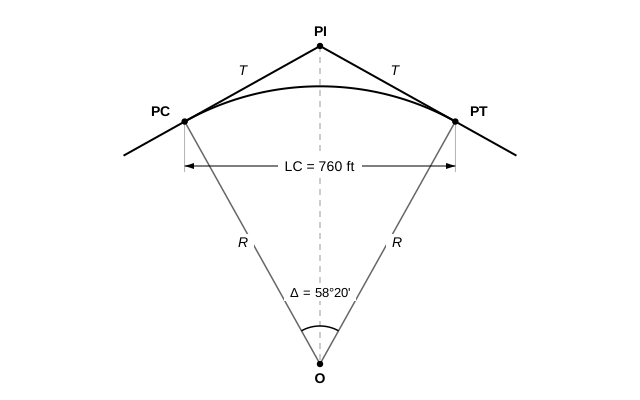
A simple circular horizontal curve has intersection angle \( \Delta = 58^{\circ} 20' \) and long chord \( LC = 760 \,\mathrm{ft} \). What is the curve radius \( R \) (\( \mathrm{ft} \)), nearest \( 10 \,\mathrm{ft} \)?
Answer: C) \( 780\,\mathrm{ft} \)
Step 1 – Identify given information:
| Intersection angle | \( \Delta = 58^{\circ}20' = 58.333^{\circ} \) |
| Long chord | \( LC = 760 \;\text{ft} \) |
Step 2 – Long chord formula: From the FE Handbook, the long chord of a simple circular curve relates to the radius and intersection angle by:
\( LC = 2R \sin\!\left(\dfrac{\Delta}{2}\right) \)
Rearranging for \( R \): \( R = \dfrac{LC}{2 \sin(\Delta/2)} \)
Step 3 – Substitute and solve:
\( R = \dfrac{760}{2 \sin(58.333^{\circ}/2)} = \dfrac{760}{2 \sin(29.167^{\circ})} = \dfrac{760}{2(0.4873)} = \dfrac{760}{0.9747} = 779.7 \;\text{ft} \)
Step 4 – Answer: Rounded to the nearest \( 10 \;\text{ft} \): \( R \approx 780 \;\text{ft} \). Option (A) \( 730 \) is too small, (B) \( 760 \) would be the radius only if \( \Delta \) were exactly \( 60^{\circ} \) (\( \sin 30^{\circ} = 0.5 \)) — a tempting round-number trap, and (D) \( 820 \) overshoots the calculation.
Correct answer: (C)
Problem 3
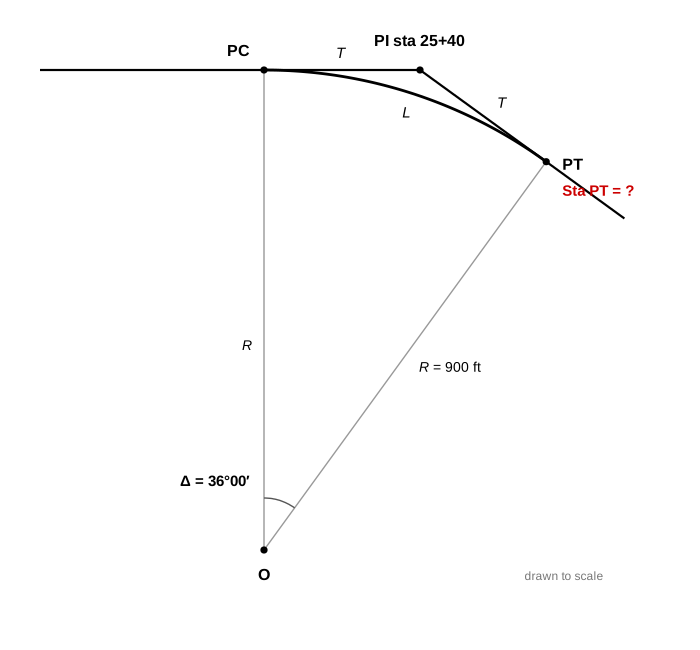
A horizontal curve has \( PI \) at \( \text{sta } 25+40 \), radius \( R = 900 \,\mathrm{ft} \), and intersection angle \( \Delta = 36^{\circ} 00' \). What is the station of \( PT \) (nearest \( 1 \,\mathrm{ft} \))?
Answer: B) \( \text{sta } 28+13 \)
Step 1 – Identify given information:
PI at sta 25+40 (\( 2540.0 \) ft), \( R = 900 \) ft, \( \Delta = 36^{\circ}00' \).
Step 2 – Locate the PC (back along the tangent):
\( T = R\,\tan\!\left(\dfrac{\Delta}{2}\right) = 900\,\tan(18^{\circ}) = 292.4 \;\text{ft} \)
\( \text{sta PC} = 2540.0 - 292.4 = 2247.6 \;\text{ft} = \text{sta } 22+47.6 \)
Step 3 – Curve length:
\( L = R\,\Delta_{rad} = 900\,(36^{\circ})\!\left(\dfrac{\pi}{180^{\circ}}\right) = 565.5 \;\text{ft} \)
Step 4 – Station of PT (forward along the curve):
\( \text{sta PT} = \text{sta PC} + L = 2247.6 + 565.5 = 2813.1 \;\text{ft} = \text{sta } 28+13.1 \approx \text{sta } 28+13 \)
Option (C) \( 28+32 \) is the classic trap \( PT = PI + T \): stationing runs along the route (the curve), and the PI is not on the route — never station through it.
Correct answer: (B)
Problem 4
A horizontal curve has radius \( R = 850 \,\mathrm{ft} \) and intersection angle \( \Delta = 42^{\circ} 30' \). If \( PC \) is at \( \text{sta } 12+50 \), what is the station of \( PT \) (nearest \( 1 \,\mathrm{ft} \))?
Answer: B) \( \text{sta } 18+81 \)
Step 1\(– L = RΔ(π/180) = 850(42.5)(π/180) = 630.5 ft;\)
Step 2\(– sta PT = 12+50 + 630.5 ft = 18+80.5 ≈ sta 18+81\)
Correct answer: (B)
Problem 5
Using the \( 100\text{-ft} \) arc definition of degree of curve, what is the degree of curve \( D \) (deg) for a radius \( R = 1200 \,\mathrm{ft} \) (nearest \( 0.01 \) deg)?
Answer: C) \( 4.77^\circ \)
Step 1 – Identify given information: Radius \( R = 1200 \;\text{ft} \), using the 100-ft arc definition of degree of curve.
Step 2 – Degree of curve formula: From the FE Handbook:
\( D = \dfrac{5729.58}{R} \)
Step 3 – Substitute and solve:
\( D = \dfrac{5729.58}{1200} = 4.7747^{\circ} \approx 4.77^{\circ} \)
Step 4 – Answer: \( D \approx 4.77^{\circ} \). Options (A) \( 3.82^{\circ} \) would require \( R \approx 1500 \;\text{ft} \), (B) \( 4.25^{\circ} \) requires \( R \approx 1348 \;\text{ft} \), and (D) \( 5.31^{\circ} \) requires \( R \approx 1079 \;\text{ft} \).
Correct answer: (C)
Using the FE Reference Handbook for Transportation Engineering
Everything you need sits in the Transportation chapter, but the search box matches words, not symbols. Search sight distance and vertical curve before exam day so you already know the two crest-curve equations appear as a pair, one for S less than L and one for S greater than L. Bookmark the horizontal curve figure; its geometry labels save more time than the formulas do.
Four Mistakes That Cost Points
- Skipping the S versus L check Crest and sag curve length equations come in pairs, one valid when the sight distance is shorter than the curve and one when it is longer. Assume a case, compute L, then verify the assumption actually held. If it did not, redo it with the other equation.
- Losing the 1.47 conversion Speed appears in miles per hour in some handbook equations and feet per second in others. The reaction term of stopping sight distance uses 1.47Vt with V in mph. Write units beside every number before multiplying; unit slips cost more points on this topic than concept errors do.
- Mishandling grade signs in sight distance Grade enters stopping sight distance as a decimal added to or subtracted from the friction term, and a downgrade lengthens the required distance. Entering a 3 percent downgrade as minus 3 instead of minus 0.03 produces an answer that is off by orders of magnitude yet still looks plausible.
- Stationing the curve from the wrong point The PC station is the PI station minus the tangent length T, but the PT is the PC plus the curve length L, not the PI plus T. Adding T twice is the single most common arithmetic error in horizontal curve layout problems, and it matches a distractor.
Frequently Asked Questions
How many transportation questions are on the FE Civil exam?
NCEES lists 9 to 14 questions for Transportation Engineering out of 110, roughly 8 to 13 percent of the exam. That places it among the larger civil-specific areas. Because the topics repeat in predictable forms, horizontal curves, vertical curves, and sight distance above all, it is one of the better areas to over-prepare relative to the study time it costs.
Do I need the AASHTO Green Book for FE transportation problems?
No. Every design value and equation you are expected to use is reproduced in the NCEES FE Reference Handbook, which is the only reference available on screen at the test center. Studying from the Green Book is not wrong, but practice with the handbook's own notation and table layout so nothing looks unfamiliar while the clock is running.
What is the difference between degree of curve by arc and by chord?
The arc definition is the central angle subtended by a 100-foot arc; the chord definition uses a 100-foot chord. Highway work uses the arc definition, and that is what the handbook provides, with D equal to 5729.58 divided by R. Read the problem statement carefully, since a chord-defined value changes R slightly on large-radius curves.
How much traffic flow theory do I actually need?
Enough to use the fundamental relationship flow equals density times speed, and the Greenshields linear speed-density model, including locating capacity at half the free-flow speed and half the jam density. You should also apply a peak hour factor to convert an hourly volume into a rate of flow. Detailed Highway Capacity Manual procedures are not tested at this level.
Keep Going
Done with transportation engineering? Work through the other FE Civil knowledge areas with more free practice problems, review the full FE Civil exam topic breakdown, or plan your preparation with our FE exam study guide and study timeline.