Structural Engineering is worth 10 to 15 questions on the 110-question FE Civil exam. The items are far shorter than anything you did in a design course: a shear and moment diagram, a load combination, a column capacity check, a deflection from a standard loading case. Speed comes from recognizing the standard case, not from deriving it.
Below are five problems with full solutions that show the handbook table or equation used at each step. Structural is the area where candidates most often burn time re-deriving something the handbook already tabulates, so pay attention to which lookup each solution starts from. Work each one on paper before reading ahead.
Exam weight: NCEES lists Structural Engineering at 10-15 questions (9-14%) of the 110-question FE Civil exam. Work each problem below on paper first, then reveal the worked solution — reading a solution you have not attempted builds recognition, not recall.
What NCEES Tests in Structural Engineering
The NCEES outline for Structural Engineering spans analysis of statically determinate beams, trusses and frames; deflection of determinate structures; column analysis including buckling and slenderness; and structural determinacy and stability. Expect to read or sketch shear and moment diagrams, find reactions, and pull a deflection formula for a standard loading case straight from the handbook's beam tables rather than integrating anything.
It also covers design and detailing basics for steel, concrete, timber and masonry, plus loads and load combinations of the ASCE 7 factored form. Questions on materials stay at the code-concept level: which combination governs, what a reinforcement ratio or a compact section means, how a bolt or weld capacity is computed. Nothing requires a full code book.
5 Free Structural Engineering Practice Problems
Each structural engineering problem below comes from the PECivilClick FE Civil question bank, with worked solutions, and matches the style, difficulty and format of the real exam. Attempt each one under a three-minute limit — roughly the pace the exam demands.
Problem 1
A simply supported beam \( AB \) has span \( L = 12\,\mathrm{m} \). You want the influence line (IL) for reaction at \( A \), \( R_A \). Which statement best describes the IL shape and key ordinates? [Diagram: simply supported beam with \( A \) left, \( B \) right, \( x \) measured from \( A \).]
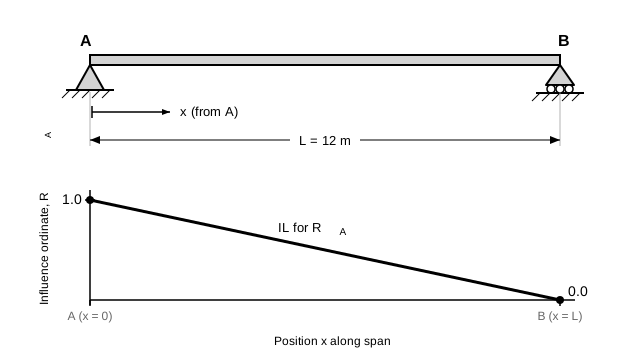
Answer: B) IL is linear from 1.0 at \( A \) to 0.0 at \( B \)
Step 1 – Identify given information: Simply supported beam \(AB\) with span \(L = 12\,\text{m}\). We need the shape of the influence line (IL) for reaction \(R_A\).
Step 2 – Influence line formula for \(R_A\): From the FE Handbook, when a unit load is placed at distance \(x\) from \(A\), equilibrium gives:
\(R_A(x) = \dfrac{L - x}{L}\)
This is a linear function of \(x\).
Step 3 – Evaluate key ordinates:
\(R_A(0) = \dfrac{12 - 0}{12} = 1.0\) (unit load at \(A\))
\(R_A(12) = \dfrac{12 - 12}{12} = 0.0\) (unit load at \(B\))
Step 4 – Answer: The IL is a straight line from \(1.0\) at \(A\) to \(0.0\) at \(B\), which matches option (B). Option (A) is wrong because the ordinate decreases as the load moves away from \(A\). Option (C) is wrong because the IL for a reaction on a simply supported beam is always linear, not parabolic. Option (D) reverses the endpoints.
Correct answer: (B)
Problem 2
A simply supported beam \( AB \) has \( L = 12\,\mathrm{m} \). Two point loads move together: \( P_1 = 20\,\mathrm{kN} \) and \( P_2 = 30\,\mathrm{kN} \), with a fixed spacing of \( 6\,\mathrm{m} \) (\( P_2 \) is \( 6\,\mathrm{m} \) to the right of \( P_1 \)). You want to MAXIMIZE reaction at \( A \), \( R_A \). Where should the GROUP be positioned (approximately)?

Answer: A) Place \( P_1 \) at \( A \) and keep \( P_2 \) inside span if possible
Step 1 – Identify given information:
| Span | \(L = 12\,\text{m}\) |
| \(P_1\) | \(20\,\text{kN}\) (leftmost load) |
| \(P_2\) | \(30\,\text{kN}\) (\(6\,\text{m}\) to the right of \(P_1\)) |
Step 2 – IL for \(R_A\) and strategy: The IL for \(R_A\) is \(\text{IL}(x) = (L-x)/L\), which is largest near \(A\). To maximize \(R_A\), we want both loads to have as large an IL ordinate as possible, meaning both loads should be as close to \(A\) as feasible.
Step 3 – Evaluate option (A): Place \(P_1\) at \(A\) (\(x_1 = 0\)) and \(P_2\) at \(x_2 = 6\,\text{m}\):
\(R_A = 20 \times \dfrac{12-0}{12} + 30 \times \dfrac{12-6}{12} = 20(1.0) + 30(0.5) = 20 + 15 = 35\,\text{kN}\)
Compare with option (B): \(P_2\) at \(A\) (\(x_2 = 0\)) forces \(P_1\) at \(x_1 = -6\,\text{m}\), which is off the beam. So option (B) is not feasible.
Step 4 – Answer: Placing \(P_1\) at \(A\) keeps both loads on the span and maximizes \(R_A\). Option (C) centering at midspan and option (D) placing near \(B\) both move loads away from \(A\), reducing \(R_A\).
Correct answer: (A)
Problem 3
Truss deflection by unit load method: You need the horizontal displacement at joint J. For two truss members, use \( \Delta = \sum(F_i f_i L_i / (A_i E)) \). Data: Member 1: \( F_1 = 50\,\mathrm{kN} \), \( f_1 = +0.60 \), \( L_1 = 3\,\mathrm{m} \), \( A_1 = 800\,\mathrm{mm^2} \). Member 2: \( F_2 = 30\,\mathrm{kN} \), \( f_2 = -0.40 \), \( L_2 = 4\,\mathrm{m} \), \( A_2 = 600\,\mathrm{mm^2} \). \( E = 200\,\mathrm{GPa} \). What is \( \Delta_J \) (most nearly)?

Answer: B) \( 0.16\,\mathrm{mm} \)
Step 1 – Identify given information:
| Member | \(F_i\) (kN) | \(f_i\) | \(L_i\) (m) | \(A_i\) (mm\(^2\)) |
|---|---|---|---|---|
| 1 | 50 | +0.60 | 3 | 800 |
| 2 | 30 | -0.40 | 4 | 600 |
Step 2 – Unit load method formula: \(\Delta_J = \displaystyle\sum \dfrac{F_i f_i L_i}{A_i E}\)
Step 3 – Evaluate each member contribution:
Member 1: \(\dfrac{50 \times 10^3 \times 0.6 \times 3}{800 \times 10^{-6} \times 200 \times 10^9} = \dfrac{90{,}000}{160{,}000} = 5.625 \times 10^{-4}\,\text{m}\)
Member 2: \(\dfrac{30 \times 10^3 \times (-0.4) \times 4}{600 \times 10^{-6} \times 200 \times 10^9} = \dfrac{-48{,}000}{120{,}000} = -4.000 \times 10^{-4}\,\text{m}\)
\(\Delta_J = 5.625 \times 10^{-4} - 4.000 \times 10^{-4} = 1.625 \times 10^{-4}\,\text{m} \approx 0.16\,\text{mm}\)
Step 4 – Answer: \(\Delta_J \approx 0.16\,\text{mm}\), matching option (B). The positive result indicates displacement in the assumed direction. Member 2 has a negative contribution because its real and virtual forces have opposite signs.
Correct answer: (B)
Problem 4
A simply supported beam \( AB \) has \( L = 10\,\mathrm{m} \). Consider the influence line for SHEAR just to the RIGHT of section \( C \) located \( x = 4\,\mathrm{m} \) from \( A \). A moving point load \( P = 50\,\mathrm{kN} \) crosses the span. What is the maximum POSITIVE shear at section \( C \) (\( V_C^+ \))?

Answer: B) \( 30\,\mathrm{kN} \)
Step 1 – Identify given information:
| Span | \(L = 10\,\text{m}\) |
| Section C location | \(x = 4\,\text{m}\) from \(A\) |
| Moving load | \(P = 50\,\text{kN}\) |
Step 2 – Shear IL concept: For maximum positive shear at C, the load should be just to the right of C. The IL ordinate for shear just right of section C when the load is at C is:
\(\text{IL}_{V^+} = \dfrac{L - x}{L}\)
Step 3 – Calculate maximum positive shear:
\(\text{IL}_{V^+} = \dfrac{10 - 4}{10} = 0.6\)
\(V_{C,\max}^+ = P \times \text{IL}_{V^+} = 50 \times 0.6 = 30\,\text{kN}\)
Step 4 – Answer: \(V_{C,\max}^+ = 30\,\text{kN}\), matching option (B). Option (C) \(50\,\text{kN}\) would require an IL ordinate of \(1.0\), which only occurs at a support. Option (A) is the negative shear magnitude.
Correct answer: (B)
Problem 5
A simply supported beam \( AB \) has \( L = 10\,\mathrm{m} \). Consider the influence line for reaction at \( A \), \( R_A \). A point load \( P = 30\,\mathrm{kN} \) moves across the beam. What is the maximum possible value of \( R_A \)? [Diagram: beam, moving point load.]

Answer: C) \( 30\,\mathrm{kN} \)
Step 1 – Identify given information: Simply supported beam \(AB\), \(L = 10\,\text{m}\), moving point load \(P = 30\,\text{kN}\). Find maximum \(R_A\).
Step 2 – Influence line concept: The IL ordinate for \(R_A\) is \(\text{IL}(x) = (L - x)/L\). The maximum ordinate is \(1.0\), occurring when the unit load is directly at support \(A\) (\(x = 0\)).
Step 3 – Calculate maximum reaction:
\(R_{A,\max} = P \times \text{IL}_{\max} = 30 \times 1.0 = 30\,\text{kN}\)
Step 4 – Answer: The maximum \(R_A = 30\,\text{kN}\), which matches option (C). Option (A) \(10\,\text{kN}\) and (B) \(15\,\text{kN}\) would correspond to placing the load at other locations. Option (D) \(60\,\text{kN}\) exceeds the applied load and is physically impossible for a single load.
Correct answer: (C)
Using the FE Reference Handbook for Structural Engineering
Find the beam deflection and shear-moment diagram tables in the Structural section early and know their location by feel. Nearly every determinate beam question resolves to one of those standard cases, sometimes superposed. Also flag the load combination list, since problems often supply dead, live, wind and snow values and simply ask which combination controls.
Four Mistakes That Cost Points
- Redrawing shear and moment diagrams from scratch The handbook tabulates reactions, maximum shear and maximum moment for the common simple and cantilever cases. If the loading matches, read the value. Deriving it costs three minutes on a question budgeted for two, and integration sign errors are a common way to lose an item you actually understood.
- Ignoring the effective length factor K Euler buckling problems state a support condition for a reason. Pinned-pinned K is 1.0, fixed-free is 2.0, fixed-fixed is 0.5. Using L instead of KL changes the critical load by a factor of four in the fixed-free case, and that wrong value is always sitting among the choices.
- Evaluating only one load combination Candidates compute a single combination, see a plausible number and move on. The question usually asks for the controlling factored load, which means checking every applicable combination. It is arithmetic rather than judgment, so the fix is discipline: list them, evaluate all of them, then take the maximum.
- Swapping section modulus and moment of inertia S equals I over c. Bending stress uses M over S while deflection uses I directly. Substituting one for the other produces a result with the wrong dimensions, but under time pressure people accept it. Check the units on your answer: stress in psi or MPa, deflection in inches or millimeters.
Frequently Asked Questions
How many structural questions are on the FE Civil exam?
NCEES specifies 10 to 15 questions for Structural Engineering out of the 110 on the exam, roughly 9 to 14 percent. That is enough that skipping the area is not viable, but not so much that you need design-course depth. Aim to be fast and reliable on determinate analysis rather than deep on any single code.
Do I need to know AISC or ACI provisions for the FE?
Not the code books themselves. The exam supplies what you need in the NCEES FE Reference Handbook, and questions test the concepts a code applies rather than clause lookup: load combinations, capacity reduction factors, reinforcement limits, compact versus noncompact behavior. Being comfortable with the handbook's steel and concrete pages matters more than memorizing provisions.
Are shear and moment diagrams actually drawn on the exam?
You will not sketch anything on screen, but you will read them. Typical items give a beam and loading and ask for the maximum moment, the location of zero shear, or which of four diagrams matches. Sketching quickly on your scratch board is still the fastest route to picking the right choice.
What is the best way to practice structural problems for the FE?
Mixed sets, timed. Working ten deflection problems in a row teaches the formula but not the recognition skill the exam actually tests. Shuffle beams, trusses, columns and load combinations together so every problem starts with the question of what kind of item this is, which is exactly how it feels on exam day.
Keep Going
Done with structural engineering? Work through the other FE Civil knowledge areas with more free practice problems, review the full FE Civil exam topic breakdown, or plan your preparation with our FE exam study guide and study timeline.