Fluid Mechanics is 10-15 questions on the FE Mechanical exam, tied for the largest knowledge area. It is also the area where a single early error propagates furthest, because most problems are a chain: properties, then a control volume, then an energy balance.
Mechanical candidates get a broader version of this topic than civil candidates do, with pump performance, compressible flow and similitude added on top of the shared fundamentals.
Exam weight: NCEES lists Fluid Mechanics at 10-15 questions (9-14%) of the 110-question FE Mechanical exam. Work each problem below on paper first, then reveal the worked solution — reading a solution you have not attempted builds recognition, not recall.
What NCEES Tests in Fluid Mechanics
The specification covers fluid properties, fluid statics, energy, impulse and momentum, internal flow, external flow, compressible flow, power and efficiency, performance curves, and scaling and similarity laws. Expect a manometer reading, a force on a submerged surface, a Bernoulli application with a velocity or pressure unknown, and a head-loss calculation using the Moody diagram.
Pump questions are distinctly mechanical: match a system curve to a pump curve, compute hydraulic power and shaft power from an efficiency, or apply the affinity laws when speed changes. Similitude items ask you to match a dimensionless group, usually Reynolds or Froude, between model and prototype.
5 Free Fluid Mechanics Practice Problems
Each fluid mechanics problem below comes from the PECivilClick FE Mechanical question bank, with worked solutions, and matches the style, difficulty and format of the real exam. Attempt each one under a three-minute limit — roughly the pace the exam demands.
Problem 1 — A. Fluid properties
A fluid has a density of 850 kg/m\(^{3}\). What is its specific gravity?
Answer: B) 0.85
Specific gravity is the ratio of fluid density to water density:
\(SG = \frac{\rho_{fluid}}{\rho_{water}}\)
Given: \(\rho_{fluid} = 850\) kg/m\(^{3}\), \(\rho_{water} = 1000\) kg/m\(^{3}\)
\(SG = \frac{850}{1000}\)
\(\boxed{SG = 0.85}\)
Specific gravity is dimensionless.
Problem 2 — A. Fluid properties
Oil with a dynamic viscosity of 0.1 Pa·s and density of 800 kg/m\(^{3}\) flows through a pipe. What is the kinematic viscosity in m\(^{2}\)/s?
Answer: D) 1.25 \(\times\) 10\(^{-4}\) m\(^{2}\)/s
Kinematic viscosity:
\(\nu = \frac{\mu}{\rho}\)
Given:
- \(\mu = 0.1\) Pa·s
- \(\rho = 800\) kg/m\(^{3}\)
\(\nu = \frac{0.1}{800} = 0.000125\) m\(^{2}\)/s
\(\boxed{\nu = 1.25 \times 10^{-4} \text{ m}^2/\text{s}}\)
Problem 3 — C. Energy, impulse, and momentum
A horizontal water jet with velocity 20 m/s and cross-sectional area 0.01 \(\text{m}^{2}\) strikes a stationary flat plate perpendicular to the flow. What is the force exerted on the plate?
Answer: A) 4000 N
Using the impulse-momentum equation:
\(F = \rho Q v = \rho A v^2\)
Given:
- \(\rho = 1000\) kg/m\(^{3}\)
- \(A = 0.01\) m\(^{2}\)
- \(v = 20\) m/s
\(F = 1000 \times 0.01 \times (20)^2\)
\(F = 1000 \times 0.01 \times 400\)
\(\boxed{F = 4000 \text{ N}}\)
Problem 4 — A. Fluid properties
Water rises 25 mm in a glass capillary tube with a diameter of 1.2 mm. If the contact angle is 0° and γ = 9810 N/m\(^{3}\), what is the surface tension of water?
Answer: A) 0.074 N/m
Using the capillary rise equation:
\(h = \frac{4\sigma \cos\beta}{\gamma d}\)
Solving for surface tension:
\(\sigma = \frac{h \gamma d}{4 \cos\beta}\)
Given:
- \(h = 25\) mm \(= 0.025\) m
- \(\gamma = 9810\) N/m\(^{3}\)
- \(d = 1.2\) mm \(= 0.0012\) m
- \(\beta = 0^{\circ}\)
\(\sigma = \frac{0.025 \times 9810 \times 0.0012}{4 \times \cos 0^{\circ}} = \frac{0.2943}{4}\)
\(\boxed{\sigma = 0.074 \text{ N/m}}\)
Problem 5 — B. Fluid statics
The absolute pressure at a point 5 m below the surface of a water tank is most nearly (atmospheric pressure = 101.3 kPa, ρ_water = 1000 kg/m\(^{3}\)):
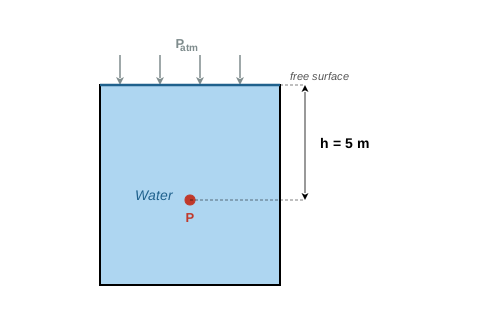
Answer: B) 150.4 kPa
Absolute pressure at depth \(h\):
\(P_{abs} = P_{atm} + \rho g h\)
Given:
- \(P_{atm} = 101.3\) kPa \(= 101,300\) Pa
- \(\rho = 1000\) kg/m\(^{3}\)
- \(h = 5\) m
\(P_{abs} = 101,300 + (1000)(9.81)(5)\)
\(P_{abs} = 101,300 + 49,050 = 150,350\) Pa
\(\boxed{P_{abs} = 150.4 \text{ kPa}}\)
Using the FE Reference Handbook for Fluid Mechanics
The Fluid Mechanics chapter contains the Moody diagram, the loss coefficient tables and the dimensionless-number definitions. The Moody diagram is the one to practise reading: you need relative roughness and Reynolds number before you can enter it, and finding the intersection on a log-log chart under time pressure is a skill, not knowledge. Do it a dozen times before exam day.
Four Mistakes That Cost Points
- Using gauge pressure where absolute is required. Gas law and compressible flow relationships need absolute pressure. Manometer and force problems usually want gauge. Reading the question for which one it specifies takes five seconds and prevents an entire class of errors.
- Applying Bernoulli across a pump or a loss. Bernoulli in its simple form assumes no energy addition and no friction. Once a pump or a significant head loss is in the system, the extended energy equation is required, and the simple-Bernoulli answer is always offered.
- Measuring centroid depth to the wrong surface. Hydrostatic force uses the depth to the centroid of the area measured from the free surface, and the centre of pressure sits below the centroid. Confusing the two locations changes the moment even when the force is right.
- Mixing dynamic and kinematic viscosity. Reynolds number can be written with either, but the density term differs between the two forms. Substituting kinematic viscosity into the dynamic form shifts the answer by orders of magnitude and can flip the flow regime.
Frequently Asked Questions
How many fluid mechanics questions are on the FE Mechanical exam?
NCEES specifies 10-15 questions out of 110, roughly 9-14 percent. It is tied with Dynamics, Thermodynamics and Mechanical Design and Analysis as the heaviest knowledge area on the exam.
How much compressible flow is tested?
A limited amount, typically Mach number, the speed of sound in a gas, and recognising when compressibility matters. Full isentropic-table nozzle analysis is beyond the usual scope, but knowing the Mach number threshold where incompressible assumptions break down is expected.
Do I need to read the Moody diagram, or can I use a friction factor equation?
Either works, and the handbook provides both. The Moody diagram is faster once you are practised at it; an explicit friction-factor correlation is more reliable if chart-reading under pressure makes you nervous. Pick one approach and rehearse it.
What is different from FE Civil fluid mechanics?
FE Civil weights fluids at 6-9 questions and emphasises open-channel flow and hydrology. FE Mechanical weights it at 10-15 and emphasises closed-conduit flow, pumps, performance curves and compressible flow. The statics and Bernoulli fundamentals are shared.
Keep Going
These topics feed into each other on the exam:
- FE Mechanical Thermodynamics practice problems — 10-15 questions on the exam
- FE Mechanical Heat Transfer practice problems — 7-11 questions on the exam
- FE Mechanical Mathematics practice problems — 6-9 questions on the exam
Done with fluid mechanics? Browse every knowledge area from the free FE Mechanical practice problem hub, see what the full bank covers on the FE Mechanical exam prep page, or plan your schedule with the FE study timeline.